
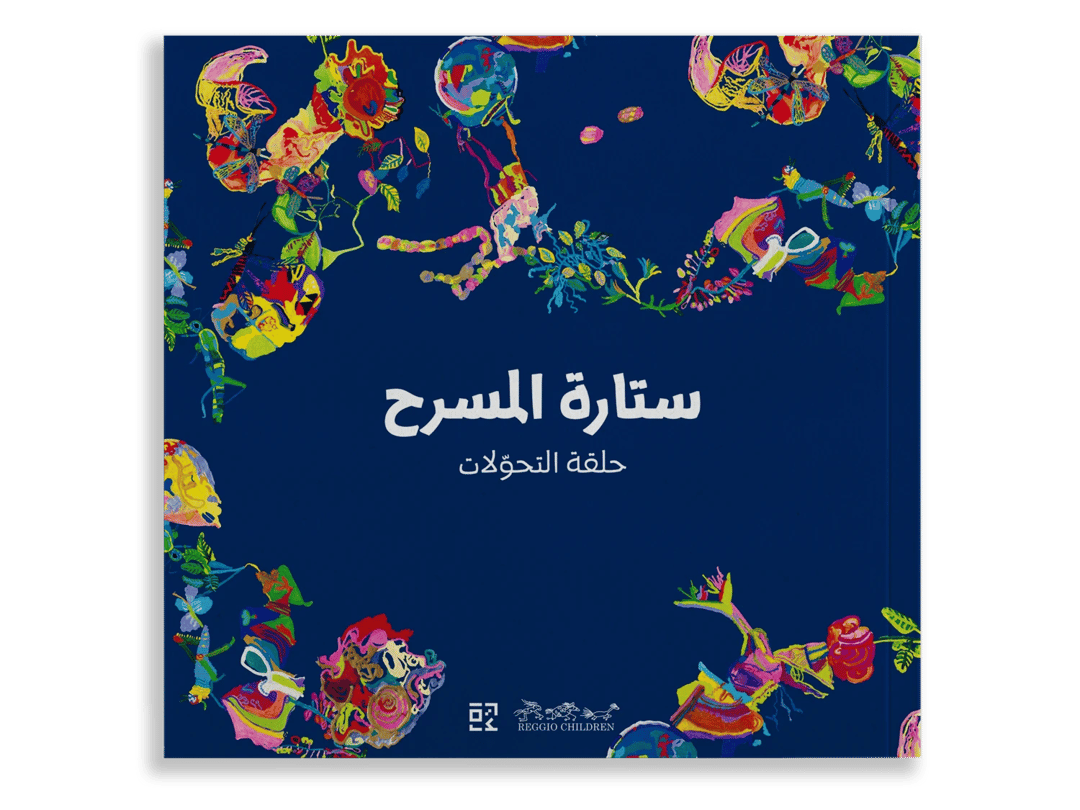
Theater Curtain
How Does Children’s Thinking and Learning Emerge and Develop in a Collective Project in Preschool?
One evening in a restaurant, as we were talking about this and that, an idea burst forth that amazed me with its vastness and its encompassing power: a special curtain for the theater! An enormous curtain designed by the children in the preschool! (Elio Canova)
The children made what seemed impossible, possible. This book is a response to the curiosity and desire to understand how the children did this, how they achieved their goal, and what tools and processes this required. (Antonella Spaggiari)
One may wonder what children aged five and six have in common with theater. There is certainly the aspect of narrative, which even very young children often use as a connective thread to create relationships between things; it is the desire and ability, through play, to represent other worlds and take on the roles of other people. (Vea Vecchi)
The story told about the curtain has its origins in the imaginative models of children and humanity: the story of life, transformative communication, and the vital energy that invents everything and transforms everything. When the curtain becomes a story and a search for meaning through narrative, it gains meaning and becomes a symbolic space. (Carla Rinaldi)
Giving young generations the confidence to make choices and carry out projects—even in contemporary aesthetic matters—means that we are looking toward the future together with them, their friends, and the people they will become in Reggio Emilia in the years to come; so that we may grow together and the children may become capable adult citizens who can competently protect all of this. (Sandra Piccinini)
About the Reggio Emilia Approach:
The Reggio Emilia Approach® is an educational philosophy based on the image of a child with strong potentialities for development and a subject with rights, who learns through the hundred languages belonging to all human beings, and grows in relations with others.




© 2025 All Rights Reserved.